On Palimpsests
A working model for layered authorship across architecture, design, publishing, and AI.

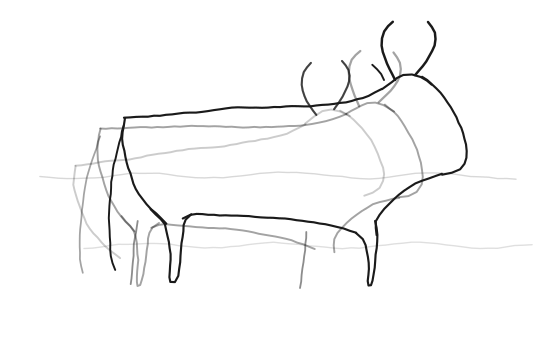
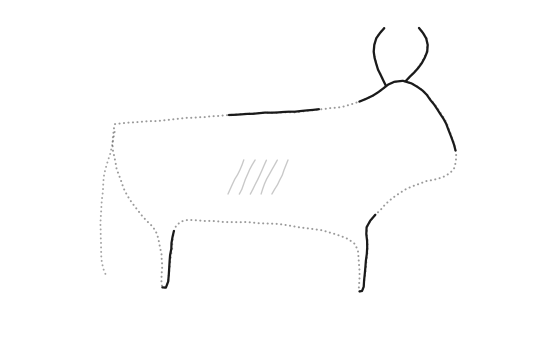
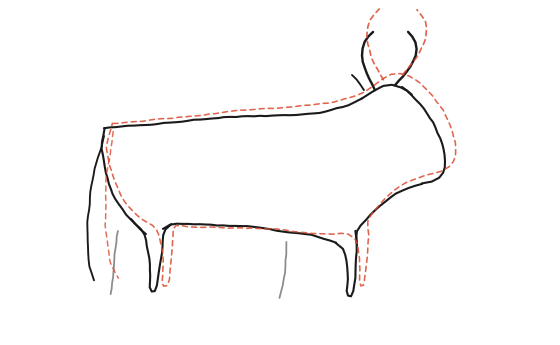
Palimpsest, four states. Original. Vandalized. Scrubbed. Recreated. The fourth panel restores the image without restoring the original: the cattle have shifted, the hands are different, and the wall now contains every intervention that came between.
Palimpsests are everywhere when you stop and look. The cosmic microwave background is one — fossil radiation from the universe's first inscription, still present, still measurable, never quite cleared. So is the Lower East Side, where every building bears at least three lifetimes' worth of paint, signage, ductwork, and zoning rationale, all visible to whoever cares to see. So is anything Robert Moses ever touched, which is most of New York. Once you start looking for these registrations of prior decision, you can't stop. Every visible thing has been considered, decided about, agreed to — or imposed — and overwritten by some next inscription. I am aware of this in my own fields, and it shapes how I both design and perceive design. This study makes that operational — three working principles for the layered condition, and an argument for what they do to authorship. The places come first, because that's where the principles came from.
It does not take a monument. The bodega down the block from my apartment was, until recently, a classic vernacular New York deli — fluorescent light, taped-up Lotto signs, and a single cat, Onyx, with patrol authority over the cold cases; if I jangled my keys she appeared out of chip packages. It is now a "mega deli." New glass cases sit precisely where the old ones did. Yankee's blue plastic paneling has been installed neatly upon the existing structure of the previous one. The new owners know nothing of the molded tin ceiling now hidden above their dropped tile, whose replacement was unfortunately value engineered. The griddle is in the same place, but there's neon now, and the new cat does not seem up to the job.
From my apartment on the southern edge of Prospect Park, you can stand on a corner and watch a road end — not because the city stopped building it, but because Robert Moses cut a trench through the neighborhood and the road on the far side became a different road, with a different name and a different relationship to everything around it. The building vernacular is identical on both sides, a dead giveaway. The trench did what Moses’ trenches always did — displaced working-class families, traded the intimacy of residential cross-streets for placeless car washes — and then it stayed, the way inscriptions do. I think about it most days because the traces are all there. I have a window that points at them.
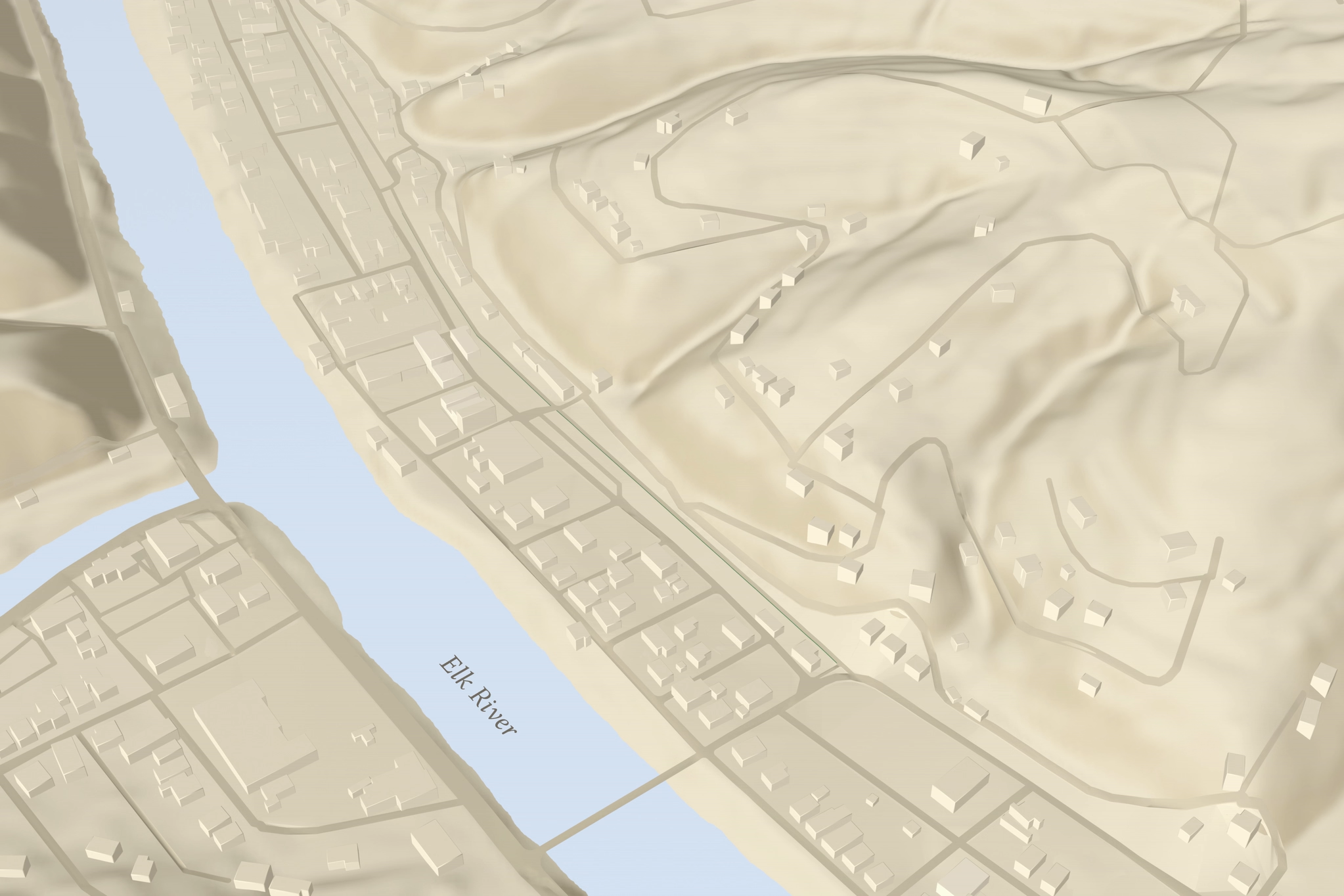
Four hundred miles southwest is Clendenin, West Virginia — my mother's hometown. A century ago Union Carbide opened a chemical plant on the Elk River, and Clendenin boomed around it. The plant is gone now. The boom is too. But what's left is not a history; it's an inventory of decisions still running. A road network sized for shift changes that no longer happen. A railbed laid and abandoned, now a 73-mile recreation trail with Clendenin as a trailhead town. And at the corner of Maywood Avenue and Main Street, a small storage building that predates any plan — it went up in the 1920s where logging wagons stopped, and Maywood has bent around it ever since. A hundred years of traffic negotiating one anonymous decision, made by people whose names nobody at the trailhead knows. The trail's arrival opened an interstitial space along Maywood, and that space is where I am proposing the town's next inscription: a pedestrian commons running parallel with the town — not a correction of the old layers, but a continuation of them. The proposal is drawn below the way I actually think about it: in layers.
I have come to take these registrations as material. They are not background. They are not nostalgia. They are the field on which any new inscription must be made, and the substrate that determines whether the new inscription is intelligible. Architects already know this in the hands, if not in the argument: we go through trace paper like it's nothing, sheet over sheet, the last drawing showing through the next. What follows is that habit taken off the drafting table. Three working principles have distilled themselves out of the question of what to do with the layered condition — the Maywood plan is what they look like applied. None is novel. Together they form a method, and the rest of this study states it plainly: the principles first, then an argument for what they do to authorship, now that machines have started writing on the same wall.
Three principles.
Layer, don't erase.
Existing conditions are not obstacles to remove. They are material: prior use, memory, structure, failure, and atmosphere. The work begins by deciding which traces should remain legible and which should recede beneath new inscription. The decision is not preservationist, but rather editorial.
Reveal versus conceal.
Not every layer needs to be exposed, but every layer affects the reading. Design becomes an editorial act: selecting, cropping, emphasizing, and letting some things work quietly beneath the surface. Total exposure is not clarity — it is noise. The strong move is hierarchy, not display.
Design in time.
A project is not finished at launch. It continues through use, weathering, maintenance, interpretation, and revision. Good work anticipates change rather than pretending to be permanent. The designer who plans for the second draft is not failing the first. They are strategically conceding to the form's actual life.
Taken together, the three principles describe a practice that behaves less like a statement and more like a conversation — one that expects to be answered. They describe what to do; the analysis below describes why it works, where it strains, and what becomes possible when the field is taken as material rather than as obstacle.
Authorship after the blank page.
The blank page is a professional fiction.
The palimpsest matters because it breaks the clean origin story design culture often tells about itself. A project rarely begins with pure invention; it begins with residue: site history, typological memory, client language, budgetary constraint, inherited material, institutional taste, cultural reference. Architecture makes this obvious — the ground is never empty. Fashion is the least apologetic about it — every few seasons a prior decade is exhumed and rebuilt through whatever lens is currently trending, and no one pretends the reference is not the point. Publishing and branding inherit both: prior perception, and a perpetual battle with a grid drawn before the current problem existed. The designer is acting on a field already marked.
The palimpsest does not romanticize history. It makes prior condition operational.
Design as an act of reading before it is an act of making.
If the project is already layered, the designer's first responsibility is interpretive. Before form is produced, the field must be read: what is structural, what is superficial, what is accidental, what is meaningful, what is damaged, what can be overwritten without loss.
Sometimes the correct move is exposure. Sometimes concealment. Sometimes translation. Sometimes contradiction. The point is not preservation as nostalgia. The point is legibility as strategy.
The author is not erased; the author is relocated.
A palimpsest model does not weaken authorship — it makes authorship more precise. If authorship is understood only as originating form, then any admission of precedent appears to diminish it. That reading carries a cost, and the designer pays it privately: a conviction that the work must arrive from nowhere, and a suspicion that any traceable source is evidence against them. This is the artist's terminal uniqueness — a standard no practice has ever met, held anyway. But if authorship is understood as judgment, authorship becomes stronger.
Authorship is not the absence of influence. Authorship is the discipline imposed upon influence.
This is not a lower bar. It is a bar set where the work actually happens. No one is required to originate. Everyone is required to read the field, choose deliberately, and answer for what they added to it.
This is the model human practice has lived inside, more or less, since paper. It depends on time. The distance between source and output — the period during which precedent is studied, refused, transformed, and recombined — is what made the model defensible. When a building references Mies, the reference is mediated by a thousand decisions about site, climate, budget, and tenant taste. When a brand refreshes its identity, the new mark sits inside a history of legibility tests, focus groups, and sales data. The lineage is real, but it is processed. Authorship is the discipline that processes it.
A class of new tools has just collapsed that distance. The reference is no longer studied — it is absorbed wholesale and reproduced without the period of work that used to convert source into authorship. This is why the palimpsest model matters more now than it did a year ago, and why it has become useful to think about more rigorously.
AI makes the palimpsest visible by collapsing source and output.
AI is often described as a rupture. Within this framework it is better understood as an intensification. It does not create the layered condition, but instead it reveals it. Generative systems absorb prior material, compress patterns, and produce arrangements that appear coherent and singular. What seems like spontaneous authorship is a recomposition of prior inscriptions.
The discomfort around AI authorship comes from the fact that it exposes a condition design already depended on but kept at a polite distance. The difference is that human practice historically preserved time, friction, and transformation between source and result. AI reduces that distance so dramatically that the layered condition becomes difficult to ignore.
The distinction matters because not every machine writes this way. A parametric model holds every decision live inside its formulas — nothing in it is permitted to die, and so nothing in it can become a trace. Total retention is the opposite of memory. The parametric machine refuses the wall. The generative one cannot stay off it.
AI is not outside the palimpsest. It is the palimpsest under acceleration.
The question is not whether influence exists, but whether lineage is acknowledged.
Once authorship is understood as layered, the ethical stakes become sharper, not softer. A palimpsest is not permission to appropriate carelessly. It requires a higher standard of attention. Which sources are absorbed? Which voices are made invisible? Which histories are flattened into style? Which forms are extracted from social, material, or cultural context?
The test is not whether a source can be named. It is whether the layer beneath stays legible in the result — whether someone who knows where the material came from would recognize that it was read rather than taken. Careless appropriation flattens the layer and keeps the surface. Attention keeps both.
This is especially urgent with AI because the system often conceals the layers it depends on. The output arrives without provenance, citation, friction, or memory of its own formation. For a designer, that creates a responsibility to reintroduce judgment where the system removes it.
The contemporary designer becomes an editor of systems.
If form is increasingly produced through systems — CMS structures, templates, brand kits, generative tools, component libraries — then authorship moves upstream. The critical work is not only in the final object. It is in the rules, constraints, inputs, exclusions, sequences, and thresholds that determine what kinds of objects can appear.
The work is no longer to make the mark. The work is to design the conditions under which marks are made.
The strongest work makes its layers legible without becoming trapped by them.
A weak palimpsest merely accumulates. A strong one edits. It does not display every layer equally — total exposure is not clarity. It builds hierarchy. It decides what should remain visible, what should recede, what should be overwritten.
This is the designer's task: not to choose between originality and inheritance, but to make inheritance productive. The palimpsest is not an aesthetic of fragments. It is a theory of continuity under transformation.
Coda — authorship relocates.
Authorship does not disappear. It relocates. From making, to choosing. From composing, to directing. From origin, to structure.
AI does not replace authorship. It redistributes it.
I remember riding my Big Wheel around Clendenin with my grandpa, Bill, hoping to end up at the Dairy Queen — on hot days, we always did. I was four. I remember Maywood Avenue and its bottlenecked state then; that storage-now-cinderblock structure had been there for the better part of a century before I existed. I did not know any of that. I knew that the road was the road, and that the Dairy Queen was the destination, and that my grandfather was where the trip was happening. The bottleneck and the storage building and the hundred-year-old railbed were part of the wallpaper of a hometown, the way wallpaper is for everyone everywhere — invisible until pointed out, and even then, mostly invisible.
In the early schemes, I wanted the storage building to come down, and for Maywood to cut a straight line from Cardinal Street to Main Street, sailing through a new pedestrian commons and trail connection area — a grand landscape with frictionless traffic, and I would walk down it. But the building sits in Clendenin's Historic District — part of the town's story whether I liked it or not. It does not need to come down; it needs to be read: studied closely enough to be reappropriated into the new context around it, as the meeting point it has always accidentally been. Maywood's bottleneck and a new commons will not be the only layers I bring to this palimpsest. I will have my own — a kid on a Big Wheel, a grandfather, a Dairy Queen with a worn-out neon sign. The wall will still remember everything underneath, but I will be one of the things it remembers.
We each get our own, really. That is what the palimpsest does and what it asks. Not just to read what came before, but to be aware of being added to the layers.
A palimpsest is a surface written over again and again, never fully cleared. I think of design the same way: not as invention from nothing, but as the careful rewriting of what already exists.
Nothing is ever truly blank. Not even now.
A loose set of notes on the palimpsest as a written surface that carries the evidence of previous inscriptions. Useful because it describes how I already tend to work.