Claw & Egg
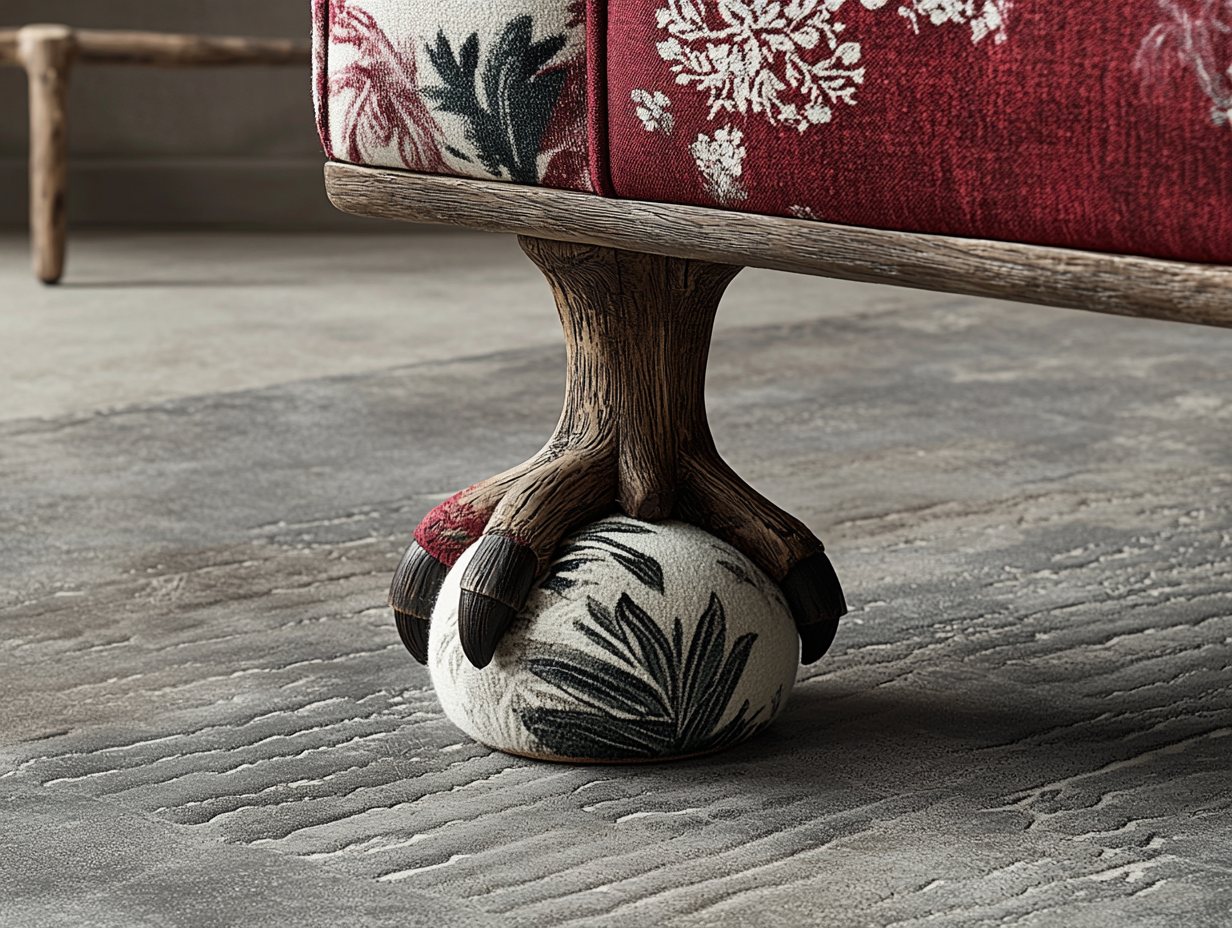
A raptor's foot holding an egg, and one talon painted. Carvers have cut those nails for three hundred years. Nobody had painted them.

*The last thing you notice. One talon in pink glitter, at the scale you would only find by crouching. Everything else on the object is trying to look like furniture.
The claw-and-ball foot has had carved nails for three hundred years, and nobody has ever painted them. This study begins there — with the polish, and with what polish is for — and works outward to what the nail then required: the claw beneath it, and the egg it made necessary.
01Where it actually starts
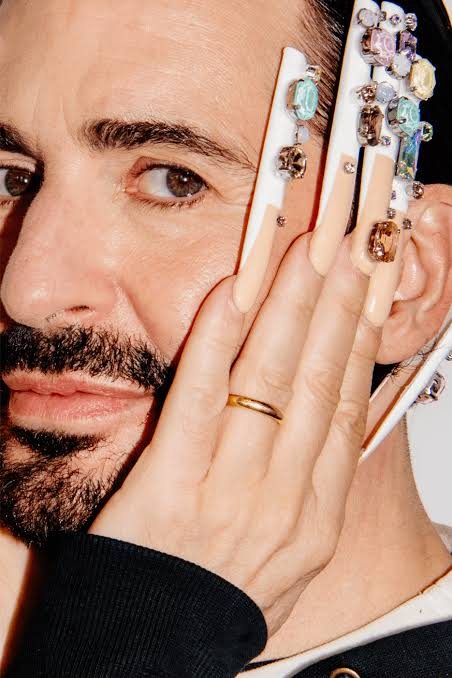
A manicure, not a foot.
Marc Jacobs grew his nails to an extraordinary length. I had worked for him years earlier, so the image did not arrive as a stranger’s — it went straight into what I was already thinking about, which at that moment was the sofa in my living room in Brooklyn.
There is a name I use for this: the fortuitous consequence. Two things with no reason to meet, meeting because of where you have already been. The combination looks random and is not. It is the only reliable way I know of to arrive somewhere you could not have aimed at.
The claw-and-ball foot already has nails. Carvers have been cutting them — cuticle, bed, the little ridge at the tip — since the early eighteenth century, and in three hundred years not one person thought to paint them.
That is the entire idea. Everything below this line is consequence.

02What the precedent forgot
The ball used to be a pearl.
On the received account, the motif is not English at all. It arrives in European cabinetmaking in the early eighteenth century as an import of a Chinese one: a dragon’s claw closing on a flaming pearl. The pearl is the point. Wisdom, power, a thing worth the grip.
By the time Georgian carvers had finished with it, the dragon was an eagle or a lion and the pearl was a sphere. The gesture survived perfectly intact. Its object was hollowed out. Generations of extraordinary carving, devoted to holding nothing in particular.
The pearl was precious. An egg is vulnerable.
Swapping in an egg is not a parody of the form. It is a correction — and an inversion. A predator’s foot closed on an egg is a genuinely unstable proposition: protecting it, or a half-second from crushing it. The object refuses to say. That ambiguity is the engine, and it is why the thing holds attention longer than its conceit could support on its own.
03The margin note
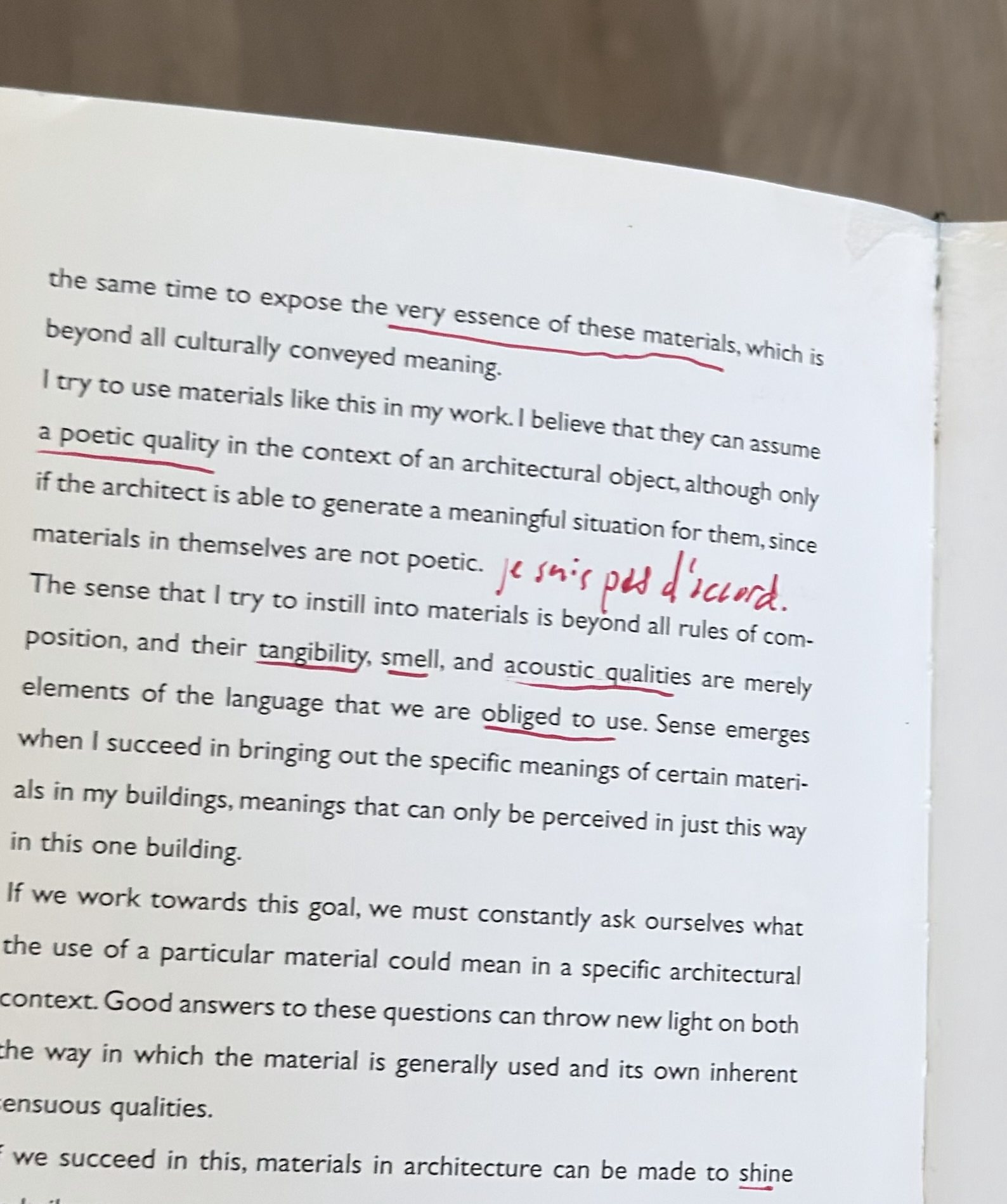
Je suis pas d’accord.
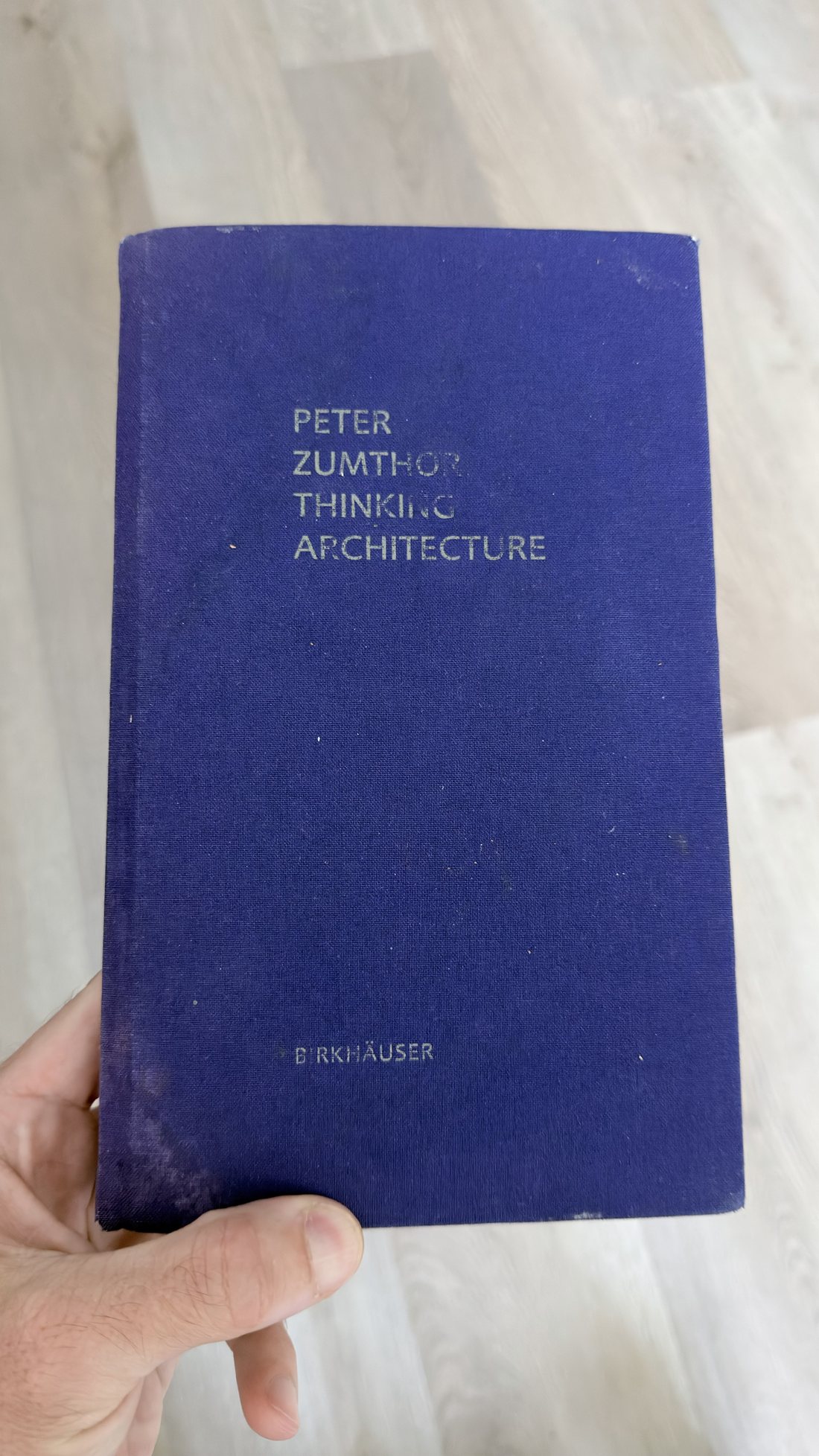
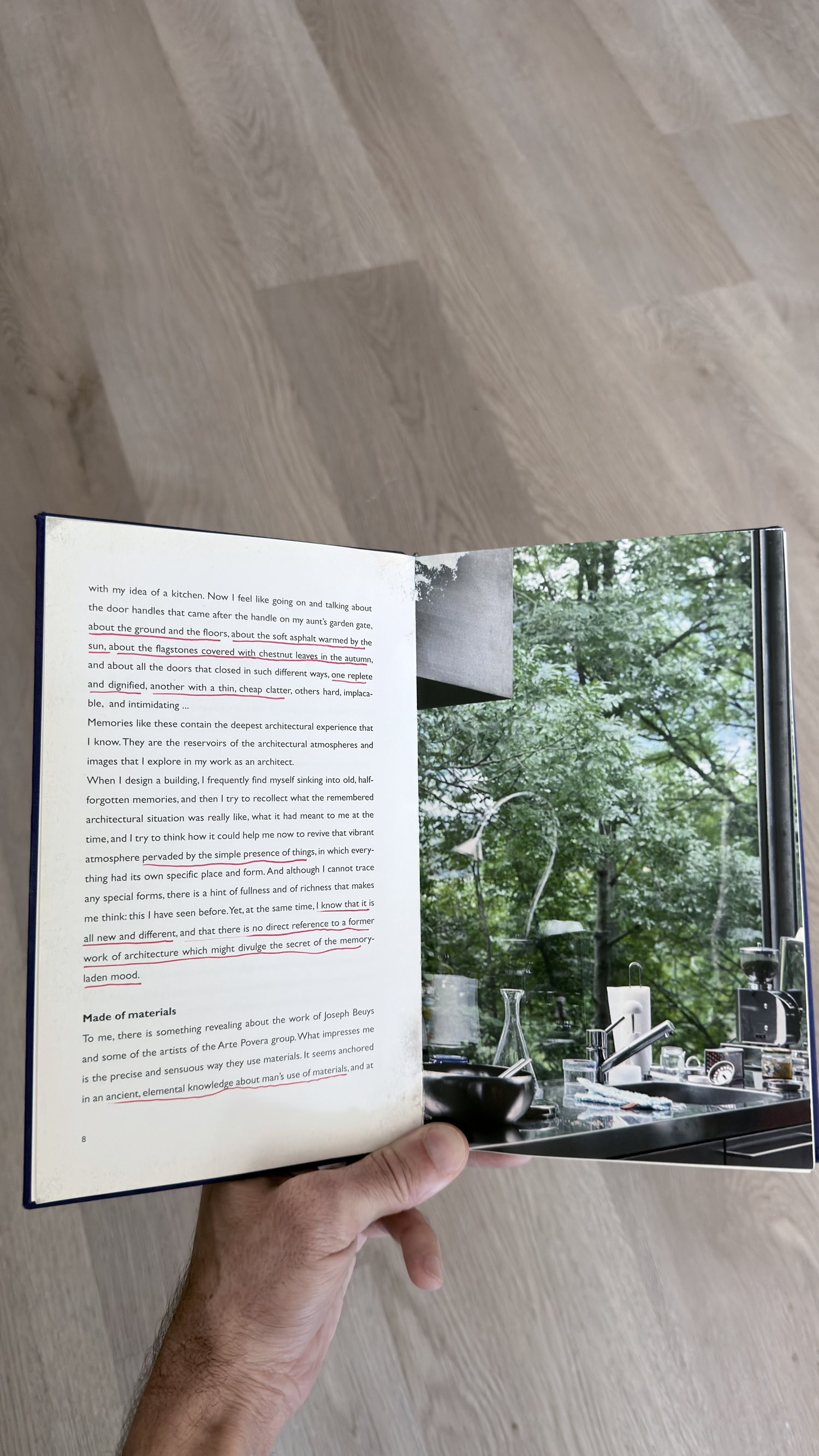
Before architecture school — still working at MJ and before I was sure I wanted it — I went to the Strand and bought a stack of architecture books to find out whether the interest was real. One of them never left my desk.
Zumthor, page ten: “materials in themselves are not poetic.” They only become poetic, he argues, when the architect generates a meaningful situation for them.
I wrote je suis pas d’accord in the margin in red pen and I have not changed my mind since.
[ this object is that disagreement, built ]
Nail polish is not poetic because a designer arranged a meaningful situation around it. It is poetic because it is nail polish — dragged out of a Duane Reade into cabinetmaking with its entire economy still attached. Bathroom cabinet. Disposable. Fashion-cycle. Applied by a person with a small brush and ten minutes.
And for good reasons: to make someone feel pretty or different. That purpose travels with the material. It is not diluted by the trip into cabinetmaking — it is the part of the polish I actually wanted.
Furniture has no category for it. That is not a styling choice. That is a category violation, and it is the best thing in the project.
04Three moves, in order
Nail, then claw, then egg.
Each one forced by the one above it. This is the order the object was actually thought in, and it is the reverse of how it is usually described.
01
The nail
The idea. A cosmetic gesture, human and reversible, applied to a piece of structure. The only mark on the object made by a person rather than a process.
02
The claw
The site the idea landed on — chosen because it was already waiting. A raptor rather than the usual lion: anatomically exact, which reads as less fantastical, not more. Accuracy is the alibi.
03
The egg
What happens when you take the first two seriously. Once you are painting the nails, the meaningless sphere is exposed, and it has to be replaced by something that earns the grip. A second material makes the egg a separate object — something the claw encountered, not something it was carved out of.
05Decisions
Seven closed. One open.
Every one of these cost something. That is what makes them decisions rather than preferences.
D01 — Scale
At full size the foot read as an oversized decorative event bolted to a sofa.
Shrink it hard. Keep it inside the footprint of an ordinary leg.
The foot became something you discover rather than something announced to you. The sofa stays calm.
D02 — The nest
A carved nest under the egg was the most attractive image produced. It was also the most explanatory: bird, plus eggs, plus nest.
Delete it. Let the egg touch the floor.
Traded charm for tension. The contact point became improbably small and the floor became part of the design.
D03 — Quantity
Four matching claw feet read as themed furniture. Novelty, immediately.
One leg per object. Every other leg stays ordinary.
The piece stopped being a set and became an intervention. It also made the modular claim legible: a system that swaps one foot at a time is a system.
D04 — Load
The talons are too slender to be trusted with a sofa, a person dropping onto it, and a vacuum cleaner.
Hidden structural core. The visible material carries shape, not load.
The object can look precarious without being precarious. The engineering disappears; the tension stays.
D05 — Orientation
A sculptural claw has a front. A threaded leg stops rotating wherever it happens to stop.
Abandon the stud. Mount on a four-hole flange plate.
A plate cannot rotate. Pages of proposed jam nuts and indexing collars became unnecessary — answered by a discarded leg found in a free box on a stoop.
D06 — The egg
Natural stone at this scale is unpredictable: flaws, chipping, cracking around a drilled core.
Cast mineral composite. Same egg volume across every version.
The egg became the constant — the shared component that turns a sculpture into a product line. Natural stone is reserved for a collector edition, later.
D07 — Presentation
Rendered in a styled interior, the room kept becoming more interesting than the object.
Freeze the room. One apartment, one sofa, one light condition, for every study.
The foot became the only variable, so changes to it could actually be judged.
D08 — Voice
Making the object structurally credible made it restrained, dark, tasteful — and it lost the thing that started it.
Not made. See below.
Everything, either way. This is the live question, and the reason this study is published unfinished.
06What the machine wanted
Most of the archive is refusals.
The visual development ran through generative image tools. There are over a hundred renders in the project folder. They are not iterations. Most of them are rejections, and the ones shown here are the few that survived a decision.
Left to itself the tool pulled in one direction, consistently and predictably: stockier proportions, a broader stance, more ornament, a bigger foot, and — over and over — an egg quietly compressed until it read as a river stone. It was reaching for the mean of every furniture catalog it had ever seen.
None of that was wanted. The stocky version in particular was never a version; it was the tool’s suggestion, declined every time it was offered.
The tool was useful for volume and useless for judgment. The work was the refusing.
Recorded here because a study that hides its instrument is not a study. And because knowing exactly what the machine reaches for — and being able to name it — is increasingly the skill.
07The problem I have not solved
One of these is sound. The other one is alive.
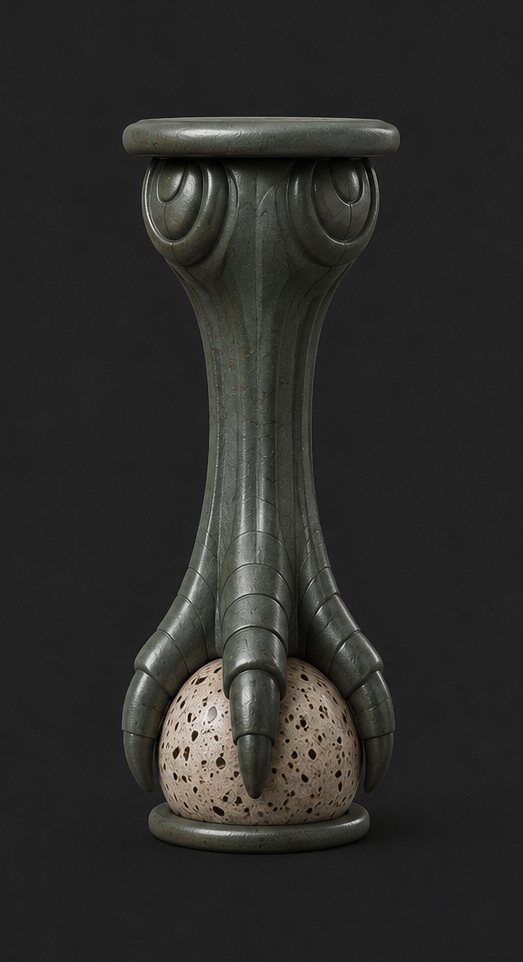

Every edit that produced A was individually correct. The egg was too big. The shaft was stocky. One leg is better than four. But a long chain of restraint edits has a direction, and the direction was taste. What is at the end of it is a beautifully resolved furniture component that a competent foundry could put in a catalog — which is exactly the low-hanging version of this, and the least interesting thing it could become.
The inversion worth sitting with: the aluminum version does not need the nail less. It needs it more. In wood, the claw already carries warmth and hand, and the nail is one more note in a warm chord. In cold patinated metal, the pink is the only thing standing between the object and a product. There it is not an accent. It is the whole argument, held in about forty square millimeters.
The nail should be the only color in the object with no relative anywhere else in it.
An earlier study painted the nail a blue-green, and it failed for a reason worth recording — teal harmonizes with the patina family. Pink harmonizes with nothing. The disharmony is the function.
08The system
A socket, a constant, and a layer anyone can author.
This is what separates a modular foot from a sculpture with an adapter glued to it.
Fixed
The mount
Four-hole flange plate to the furniture rail. Orientation is determined by the plate, not by how far a screw happens to turn.
Constant
The egg
Identical volume and floor contact in every version. Cast, not quarried. It is the component that repeats, so it is the component that gets engineered once.
Open
The claw & the nail
The authorable layer. Everything expressive lives here and nothing structural does — which is what makes a second version, and a tenth, possible without re-solving the object.

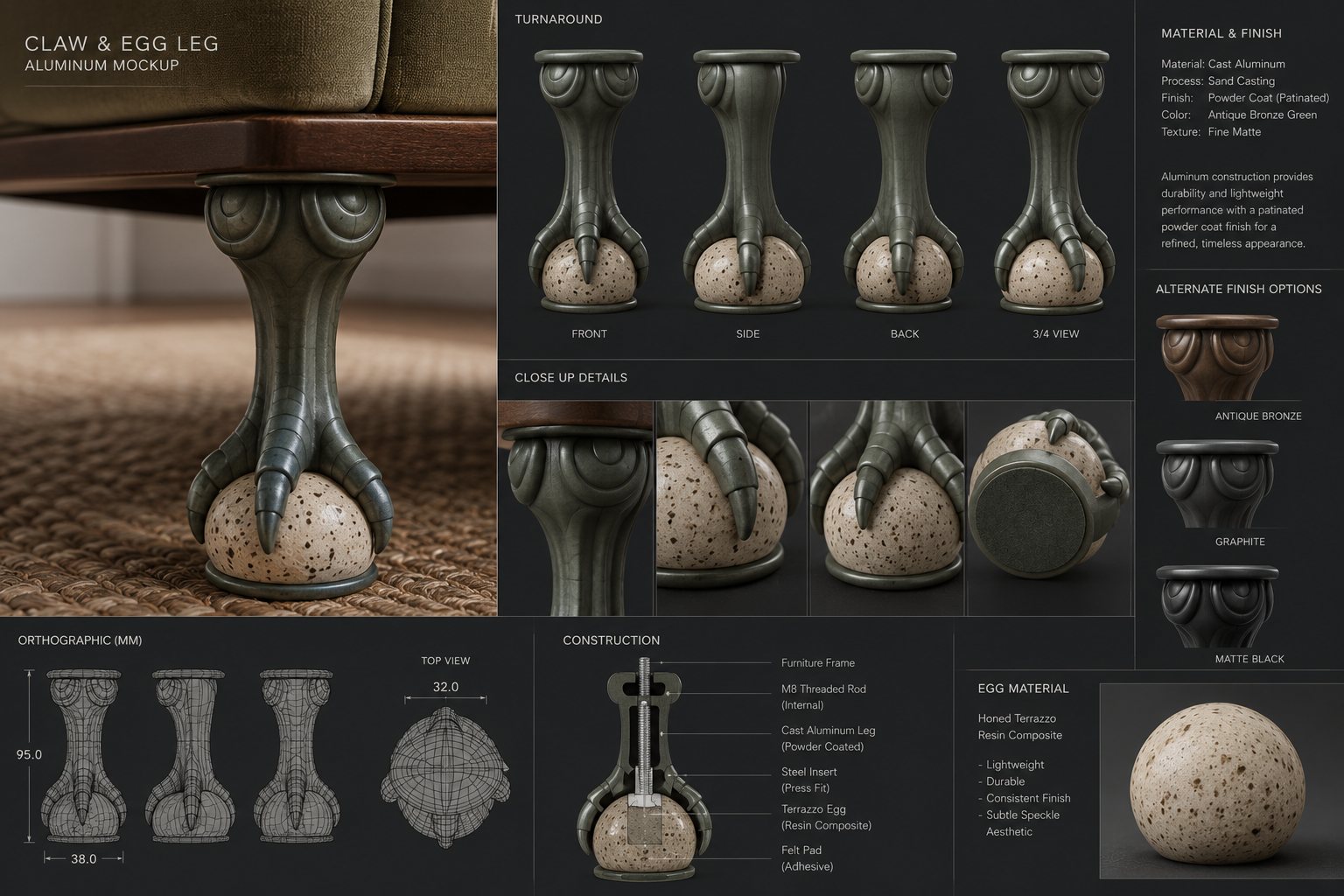
A warning about those two sheets. The dimensions, wireframes and section callouts on them are concept graphics, not verified drawings. Every number was invented by the render. Real dimensions begin below.
09In hand
The first real object is an egg.
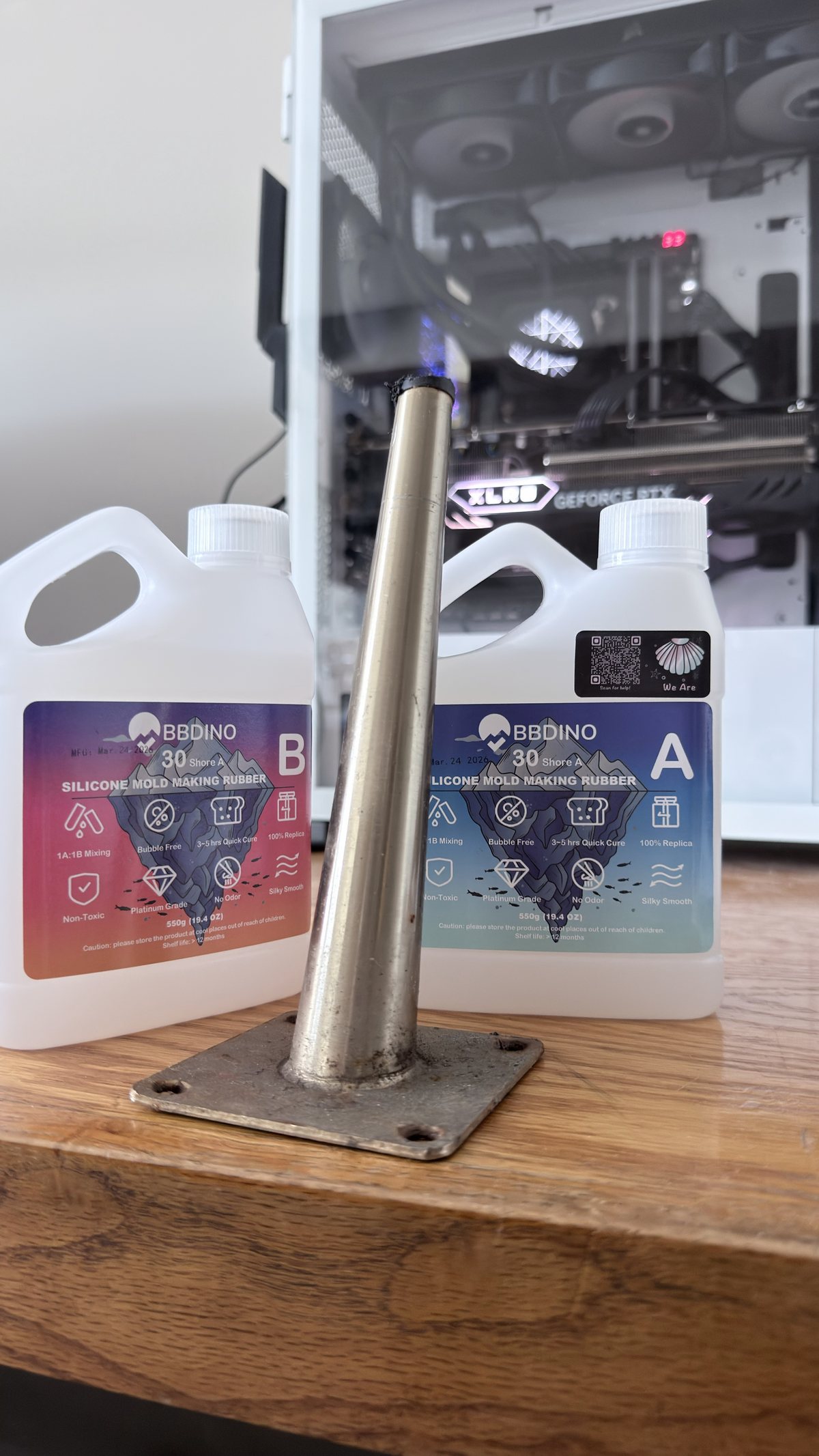
The egg gets molded first — not because it is the interesting part, but because it is the forgiving one. Near-ovoid, almost no undercut, a clean pull on the first or second attempt. It is also the constant, so proving it proves the system’s shared component, and the speckle recipe iterates for the cost of a few grams.
Then the salvaged foot: real geometry I did not design, at zero material risk, which teaches parting lines and undercuts on somebody else’s problem. Molding a discarded twentieth-century leg and recasting it also happens to be this study’s thesis performed on actual precedent instead of a photograph of one.
Then the claw.
Every dimension published before now was invented by a render.
The salvaged legs do one more thing: they are the first measurable objects in this entire project.
The engineering disappears. The tension stays.
A modular furniture foot: a raptor claw closed on a small mineral egg, replacing exactly one leg of an otherwise ordinary sofa. This is the open study beside it, published while the prototyping method is still being decided.
10Versions
Same socket. Same egg. Different hand.
Once the mount is fixed and the egg is constant, the claw and the nail become an authored layer — which means the foot is not an object so much as a proposition that different hands can answer. Written here as a sequence of influences still front of mind as much as a record of paths that crossed mine.
Chronologically this was always first. The man who wrote an address on a piece of paper at the end of a shift and changed what I do for a living.
Outwardly the most conservative object in the collection — plain, correct, white-shirt-and-jeans, mistakable for original equipment. Set a few degrees off its axis, so it faces up and away from you rather than at you, and returns to center only from one position in the room.
The claw is sealed inside the shaft. No aperture, no slot, no photograph — the most anatomy in the family and no view of it exists. Cast in bronze and finished properly on every surface, including the ones enclosed for good. Its one nail is clear.
The only version whose manicure is done and never seen.
The only house that ever treated the foot as a structural problem. He studied anatomy at USC to find where the weight actually goes, then buried a steel shank in the arch so a shoe could look impossible and still carry a person — D04, a century early. And in cork, raffia and nylon, because that is what the sanctions left him: poor materials, high intent.
Paris, before Les Sables-d’Olonne. He was working for Comme des Garçons then, out of 16 Place Vendôme. He put me in every men’s show worth seeing that week — an education I had not earned and have not stopped drawing on. Later he had me concept a guerrilla store for the house in Brooklyn. It never materialized. We are still in touch; he runs Plan 8 in Paris now.
Which makes this the one version here that is not about the claw. Plan 8 works on where a thing lands and what it is for — positioning, retail context, the architecture around an object rather than the object. So the version is the guerrilla store, finally: one room, a short lease, no signage, a set of feet installed on furniture that is already in it. Not a launch. A sighting.
Saddlery. The claw sleeved and hand-stitched, the seam left visible, the egg seated in a leather cradle. Six years at Hermès and he left the construction showing the whole time — the quietest work of his career. The offcut logic of petit h maps onto a foot made of what is left over almost without translation.
Speculative interpretations, unaffiliated and unsolicited. No association with, endorsement by, or collaboration with any named house or individual is claimed or implied.
—And one that is not speculative
A deer foot. I showed him the project and said, joking, that I’d make him one in his favorite animal. We both laughed. We both knew I was going to do it.
11The road not taken
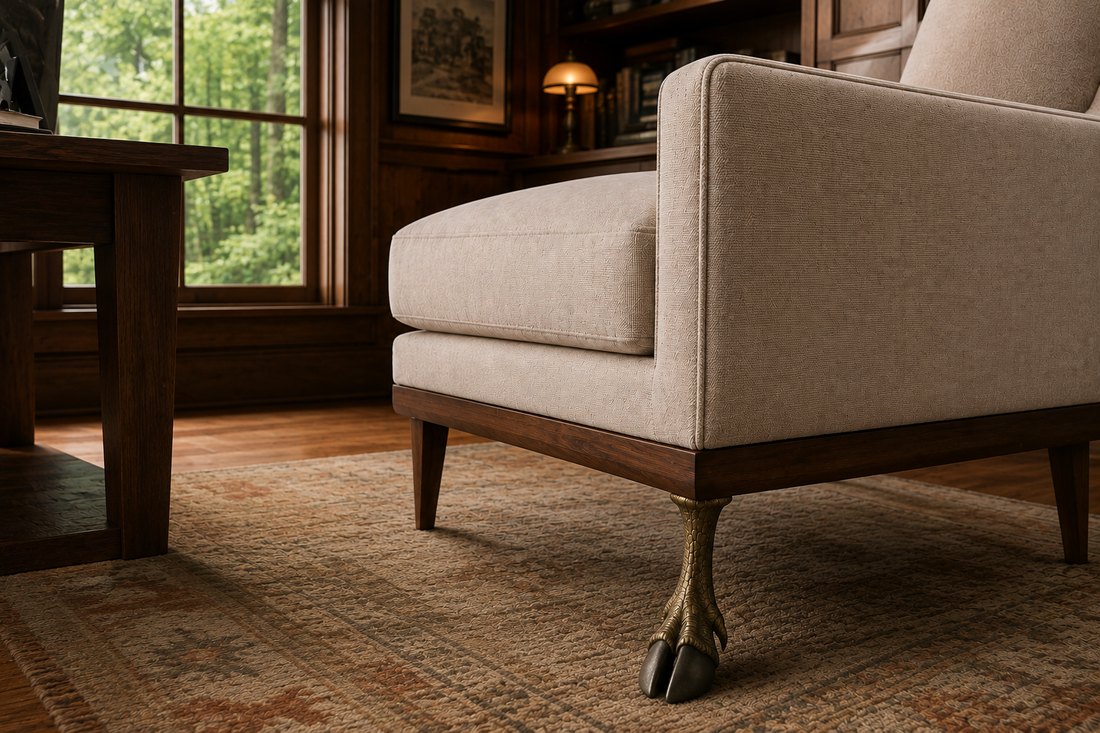
The egg wearing the sofa.
One render went the other way entirely. It is not the current direction and it is not dead — recorded here so it does not quietly disappear into a folder of a hundred-odd images.

—The log
This study is open.
Entry 01 published. Origin corrected — the nail precedes the claw, not the reverse. Seven decisions recorded, one left open. Archive audited: AI-suggested proportions separated out from decisions actually made.
Marc Jacobs version held. The obvious move, and too comfortable — the two men were half and half of the same company, so running both flattens what is interesting about either. A Duffy version without a Jacobs version is the sharper proposition. Held, not cut.
Duffy draft 02. Claw fully concealed, no aperture — the braver option, and it costs the collection its best photograph. Nail clear. Ships finished; bronze, on restraint rather than patina behavior.
Ken added. The first version owed to a person rather than proposed to a house, which is why it sits outside the speculative disclaimer. It is also the only version so far permitted to break D07 — different room, different sofa — on the grounds that the frozen room exists to isolate the foot, and this one is not about the foot.
Jonathan Anderson cut. He was on the list because I respect the work — and the respect was doing the arguing, which clouded the plainer question of whether the version belonged here. It did not. Cut, not held.
Entry 02 — the egg, in hand. First silicone mold, first cast, first speckle formulation. Photographed as an object rather than rendered as one.
Entry 03 — D08. Voice returned to the sound body, or an argument for why it cannot be.
Nothing on this page is a fabrication drawing. No load testing has been carried out. The object has not been made. What is true here is the reasoning, the sequence of decisions, and the fact that the mold rubber is already on the desk.
