Countermark
One word in 23 drafts, stacked so that its far end reads as the word again at another angle, and my voice setting how long the cut takes to cross it.
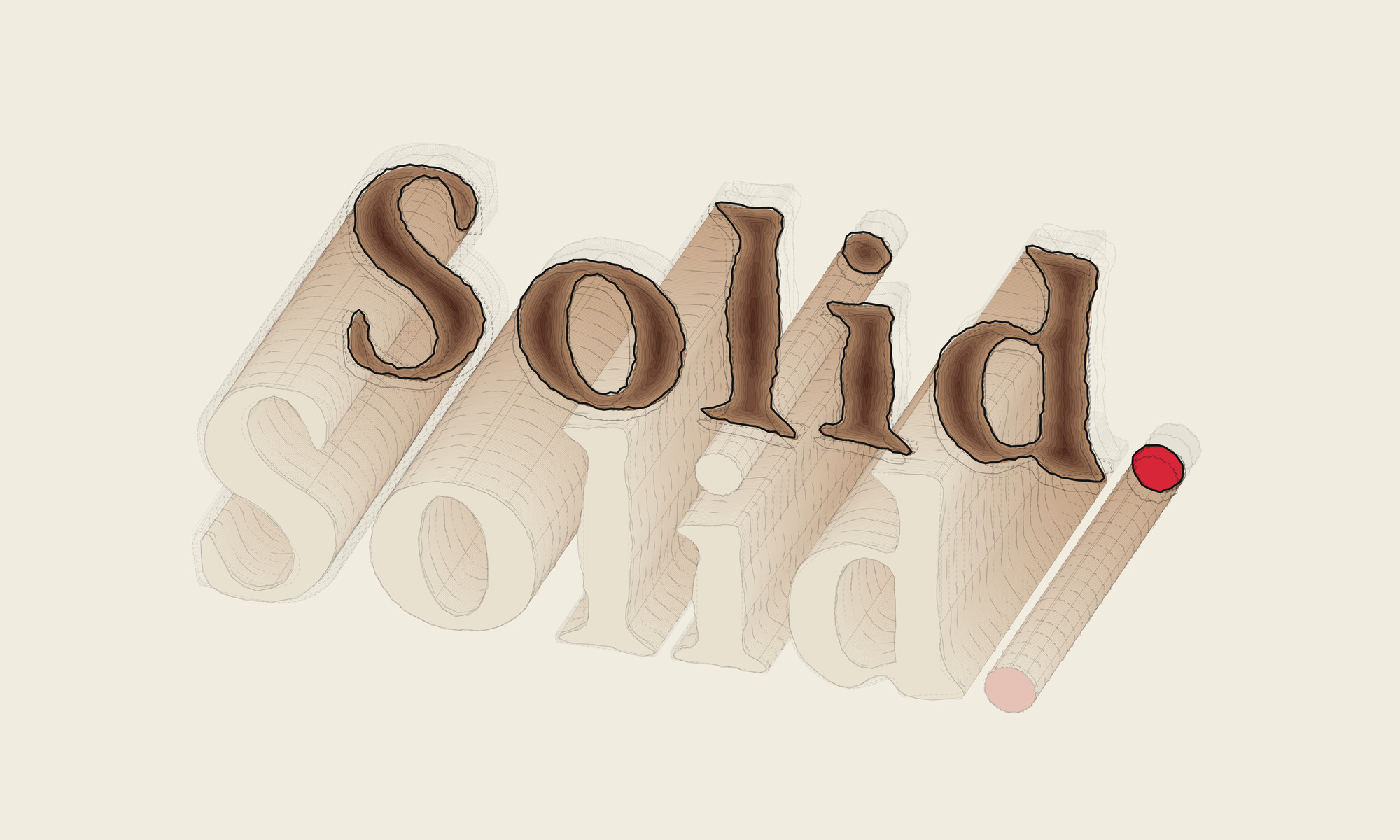
Solid ended on a second reading. Turn a stack of drafts the right way and its far end reads as the mark again, whole, at another angle. I called it the countermark, after the smaller watermark papermakers set in the opposite half of the sheet. This study is built around it: the instrument opens on one, and Play shows where it comes from.
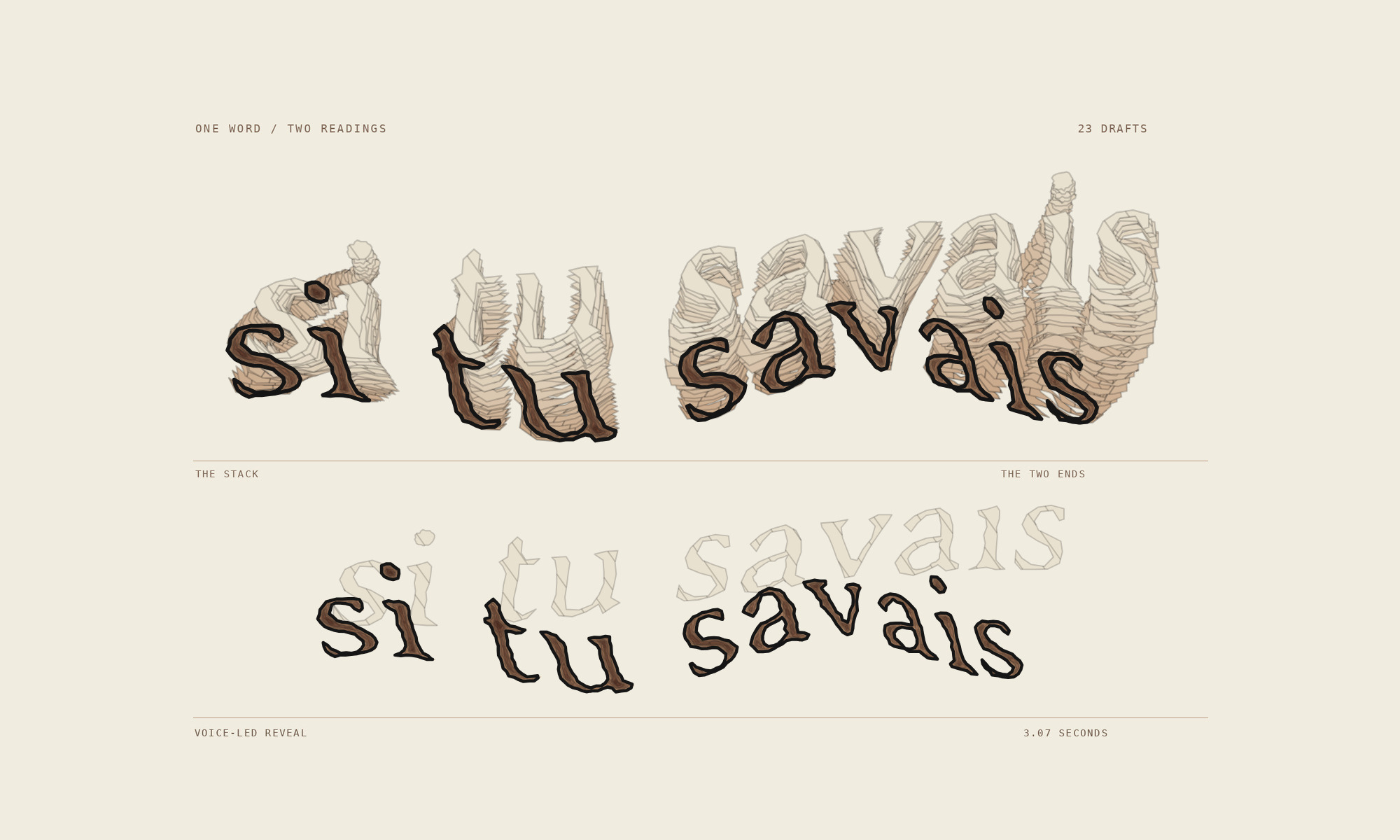
The word on the stage is [Countermark], brackets included. Clifford, one of the four families from On Palimpsests, redraws it 23 times, each draft a little different from the one before, and the drafts stand one behind the other as a single extrusion. The near end is cut at the plane and drawn dark; that is the face. The far end is the last draft, and it reads as the word again. That is the countermark. At the first frame the two left brackets, the face’s and the countermark’s, nearly sit on top of each other.
Play runs the cut from one end of the stack to the other in the time the voice takes, 3.07 seconds, and turns the view away from where the brackets meet. The two readings pull apart, the stack shows itself as one continuous move, and the cut arrives at the far end, where the face becomes the countermark. Between drafts the plane cuts exactly where it is instead of jumping to the nearest draft, so the face glides. Trace depth, in View, sets how long the extrusion is between its two ends.

The voice is mine. The instrument measures the recording and maps it onto the drawing. Its length sets how long the reveal takes. Its loudness swells each piece of the word about its own center, and its low, mid and high frequencies ripple the outline. Each draft takes the sound at its own place in the recording, so the stack holds the sentence from start to finish, and the face at the plane takes the sound under the playhead.
The mapping is designed, not found. Nothing in a recording says a loud syllable should swell a letter; that is a choice, and Audio influence sets how much of it you see. At 0 you see none of it. It opens at 1.00, where the letters swell and roughen as the sentence is spoken. At 2.00 they begin to run into each other, and the word still reads.

Here it is. Press Play, scrub T location, drag the stack to turn it, and save what you make.

There are two words in the instrument, [Countermark] and si tu savais. I tried words in place of marks, and they show it more plainly. The brackets are there for the first frame: the two left ones nearly meet, and when Play starts they come apart. The knob and the aurochs are still here, and Load SVG and Load Model take a mark or a model of your own.

Upload audio takes a recording of your own, and the reveal takes its length. Load SVG takes any filled mark, and Load Model an OBJ or STL. The files are read in your browser and never leave it. Save writes what the stage shows, as in Solid: Export SVG and Export flat set for a word, a mark or a model, and for a model, Export silhouette and Export model too.
I did not write the instrument by hand. It was built in AI-assisted sessions on top of Solid’s: the cut that glides between drafts, the voice track, Trace depth, the four tabs. The direction is mine, and so is the first frame, my own recipe: Flip side, then Clifford, then a turn of the view until the two brackets nearly meet.
Every voice leaves a shape.
A concept study and a working instrument. Solid’s four families on one word, its countermark at the far end of the stack, and a voice that sets the reveal.