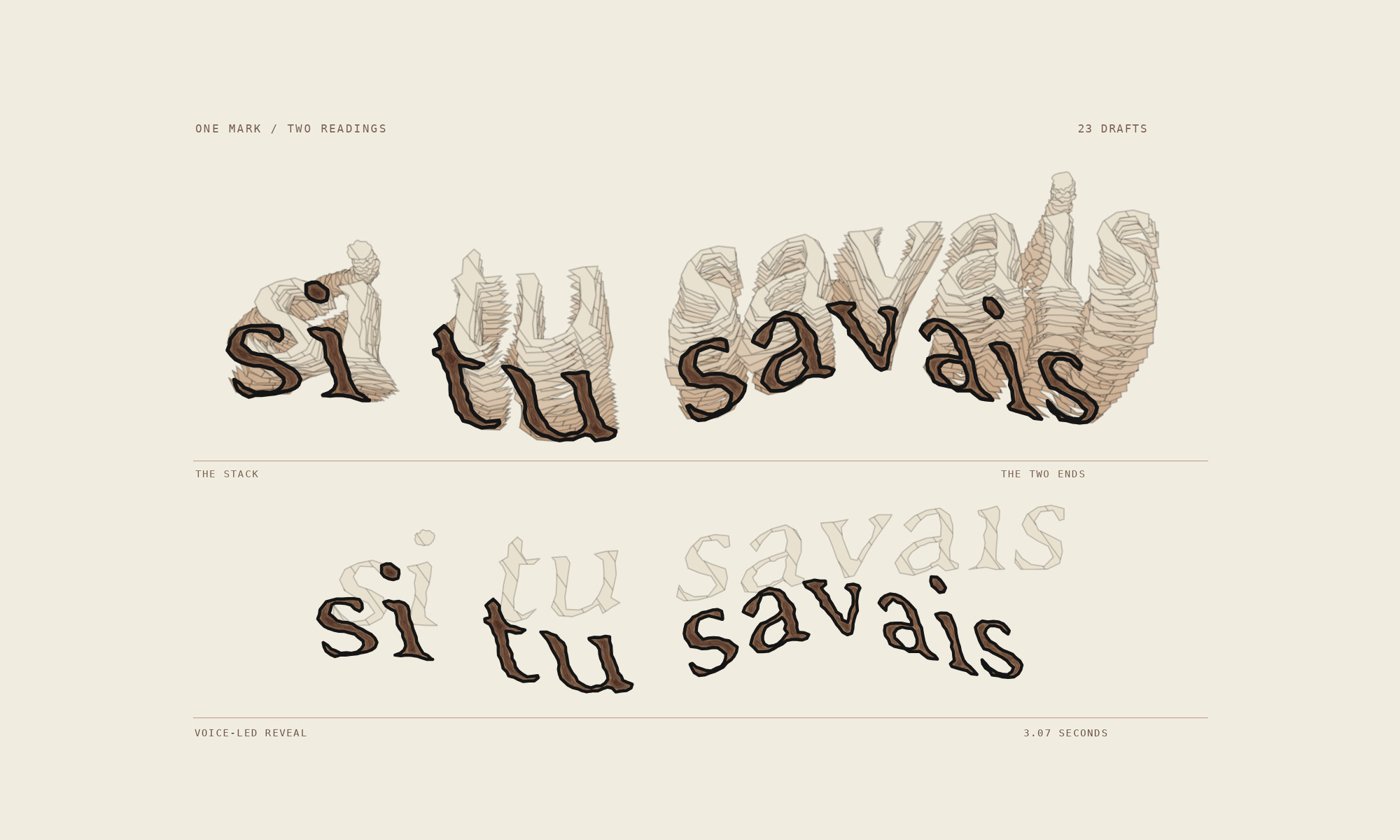
Cliff’s Condition
A mark, a bracket and a path taken from the bend of a J: 40 seconds in which an open space is compressed so that the next one can open wider.
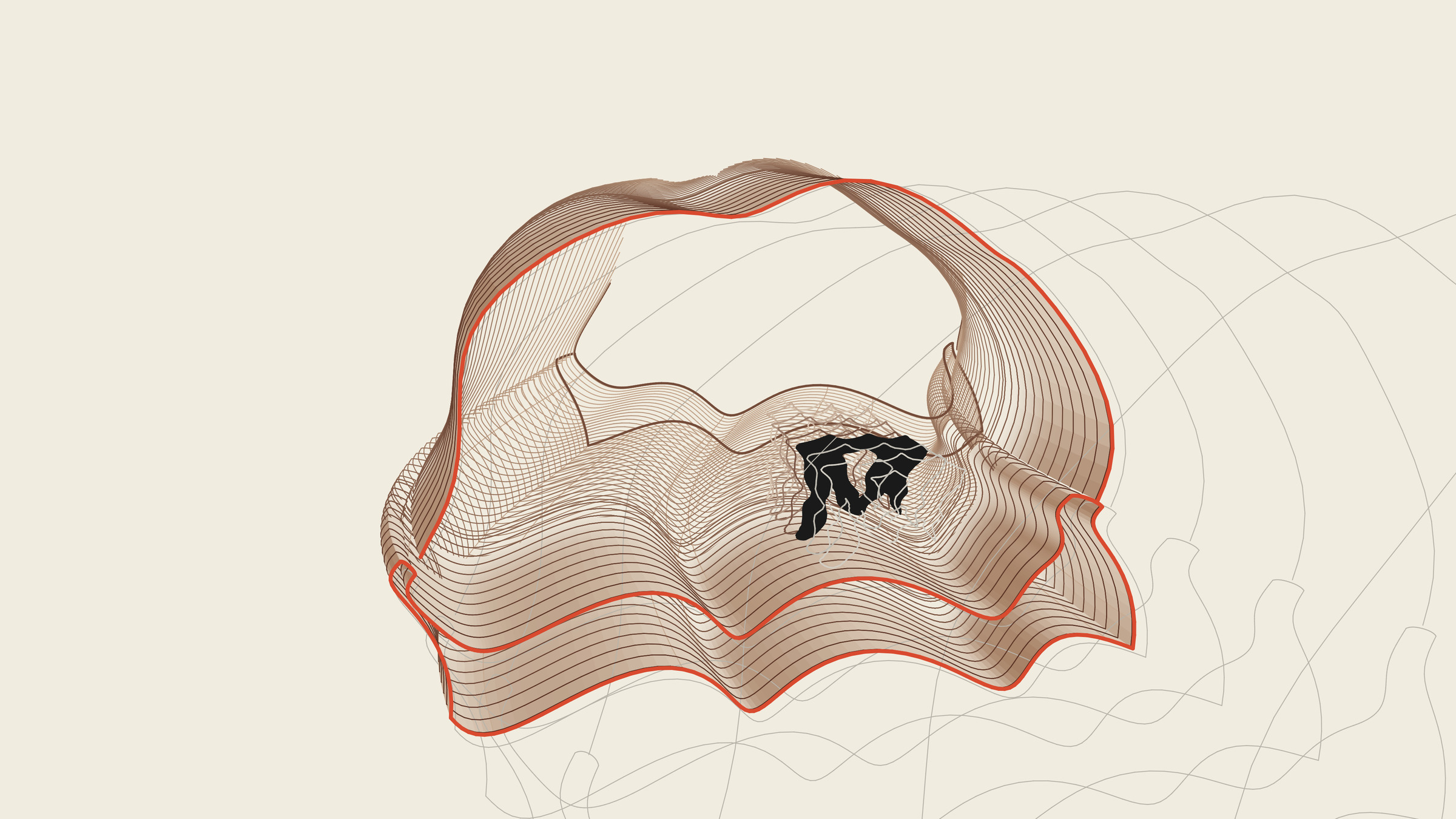
The arch. The bracket’s sides have met over the mark. The massed band behind the vermilion line is where the bracket has just been.
The studies before this one are instruments. Solid and Countermark each hand you a panel and let you find things. This one has no panel. It is a film, 40 seconds, and it is made with them: the figure in it was drawn in the Countermark instrument, and every line of the ground it travels is that instrument’s own algorithm at work. It is the first time I have used what the instruments make to tell a story.
The rules are the ones I have kept all along. Every form on screen is derived from parameters I set, and the math is only broken where I say so. It is broken once, and I will point to it.
There are two figures in it, and both are already mine. The black one is my JMT mark, abstracted with the Fourier family in the Countermark instrument until it stands on two legs. It could be any figure or any model. The vermilion one is the bracket from this site, the same glyph, lying on its back, so that its long stroke is a floor and its two short strokes are sides.
The film opens the way the two statements on my home page close: a vermilion wipe crosses the bracket, fills it, and withdraws. Then the bracket starts to move. It leaves its own drafts behind it as a surface, and the mark rides on that surface a little behind the lead.

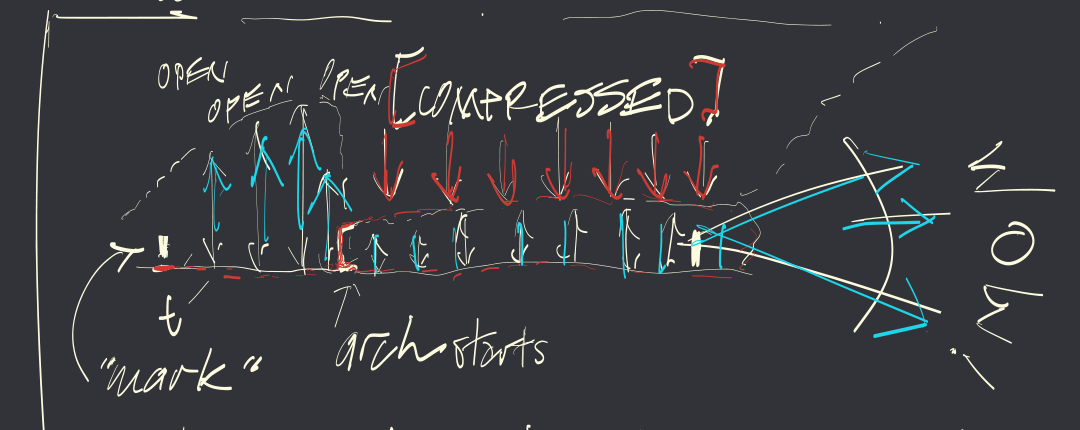
The bracket is a literary device. It lays down the path in front of the mark, and the mark follows a path that is being made as it arrives. I needed a bend in that path, and then I needed an arch.
The arch is the bracket’s own sides, carried upward until they meet. I chose it because it is the plainest shape that compresses a space. The mark has been traveling in the open; now there is a vault over it, and the vertical room it had is gone. Frank Lloyd Wright used this trick at his front doors. He called it compression and release: force someone from an open space into a low one, and the next open space feels larger than it is.
When the arch closes over the mark, the mark is startled. It jumps, grows to one and a half times its size, shakes, and comes back down. That is the one place the math is broken. Nothing in the system produces that jump. I put it there because the story needed someone to notice.
Then the path ends. The bracket reaches an edge, a cliff, and the camera comes round behind the mark so that the first thing you see of what is out there, you see through the arch. Past the edge the space that was compressed opens onto waves, fields of small arches, a mound of brackets laid flat, and far ridges. All of it is made from the same two shapes, repeated and looping. None of it is terrain. It implies terrain.
Edmund Burke separated the sublime from the beautiful: the beautiful is small, smooth and near; the sublime is vast and a little frightening. A generation later Uvedale Price put the picturesque between them. I had those three in mind as three distances. The mark on its bracket is the near one. The edge is where the far one starts.
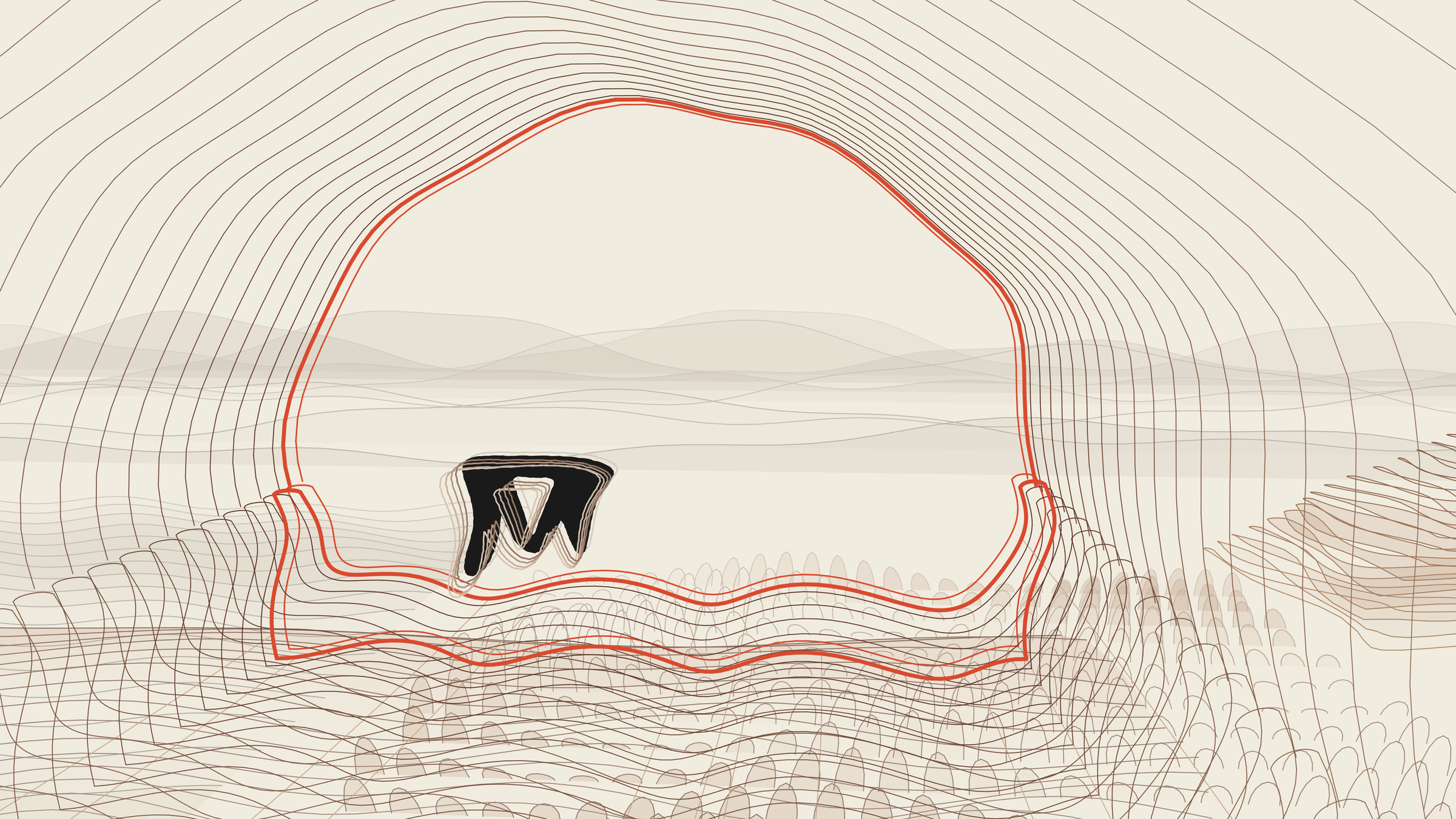
The path is not drawn by hand. It comes from the bend of the J in my mark.

I read those two curves as a valley. The line midway between them is the valley floor, the valley is as wide as the stroke, and the floor falls from the stem to the tail, the direction the stroke is drawn. Then I let something go on that ground under two forces only: the slope pulling it down, and a small random kick at every step. I ran it 320 times.
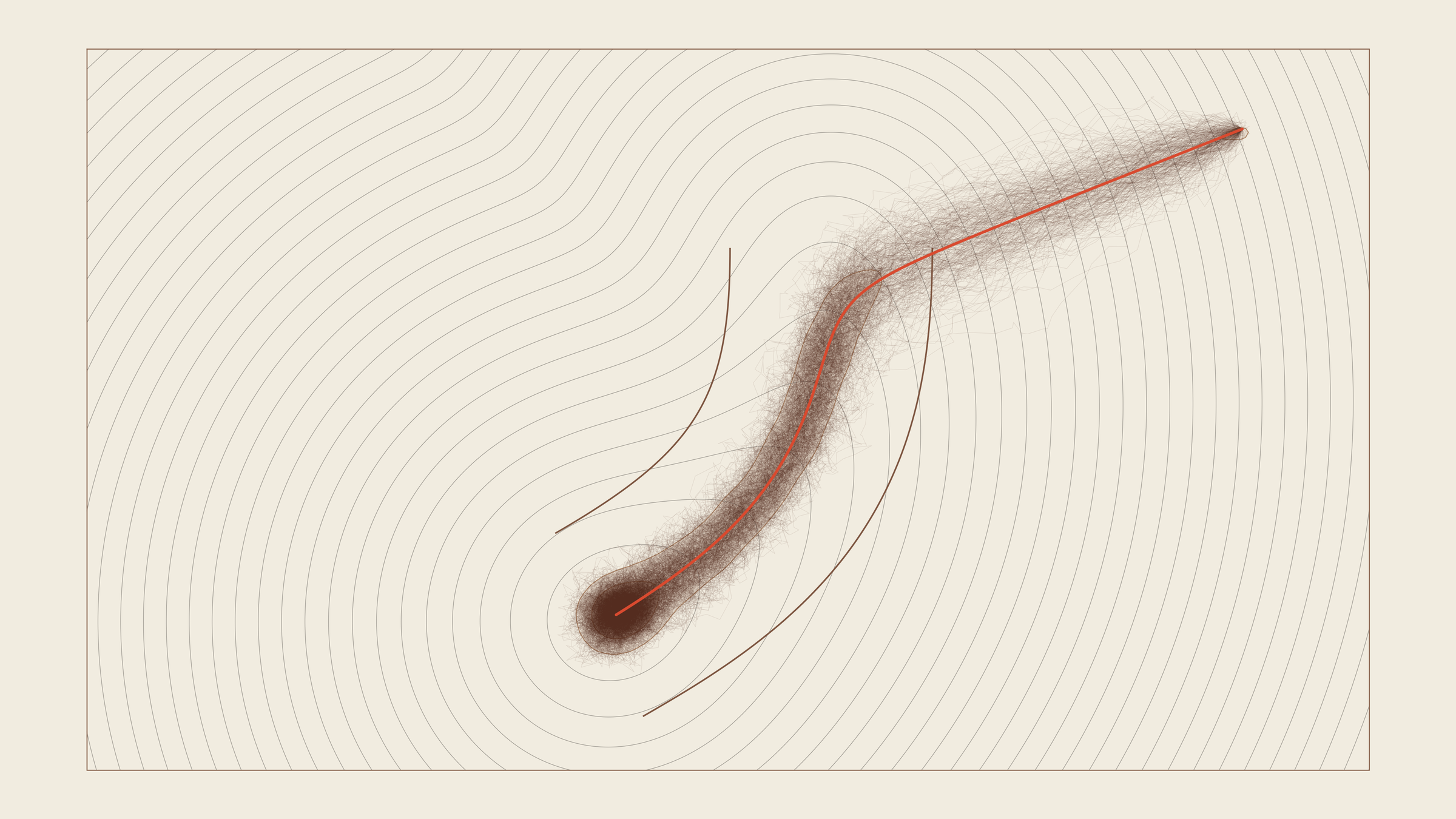
The vermilion line is the path with the kick taken away, the one the others crowd around. That is the path the bracket follows in the film. Seen from above it is the J’s own bend, approached from a distance: a long straight pull, one turn, and a stop.
It stops because of where I put it. I went to Ron Shvartsman’s lecture on the Poincaré–Bendixson theorem at Pioneer Works while I was working on this. As I understood him, a path like this one, on a flat plane it cannot leave, has only two ways to end: it comes to rest, or it settles into a loop. Mine runs downhill, so it comes to rest, at the low point by the J’s tail. The edge in the film is that point. The end of the film is the last place the path could predict.
Every line that is not vermilion is a draft of the bracket: the same outline, redrawn at each step along the path, each a little different from the last. The family that redraws it is Clifford, one of the four from On Palimpsests, and it is the same function the Countermark instrument runs, called from that engine and not retyped.
Clifford is a field of slow waves. Lay a shape on it and every point of the shape is pushed a little, by however the waves stand at that point. Because the waves are long, neighboring points are pushed nearly the same way, so the shape bends as a whole instead of breaking up.
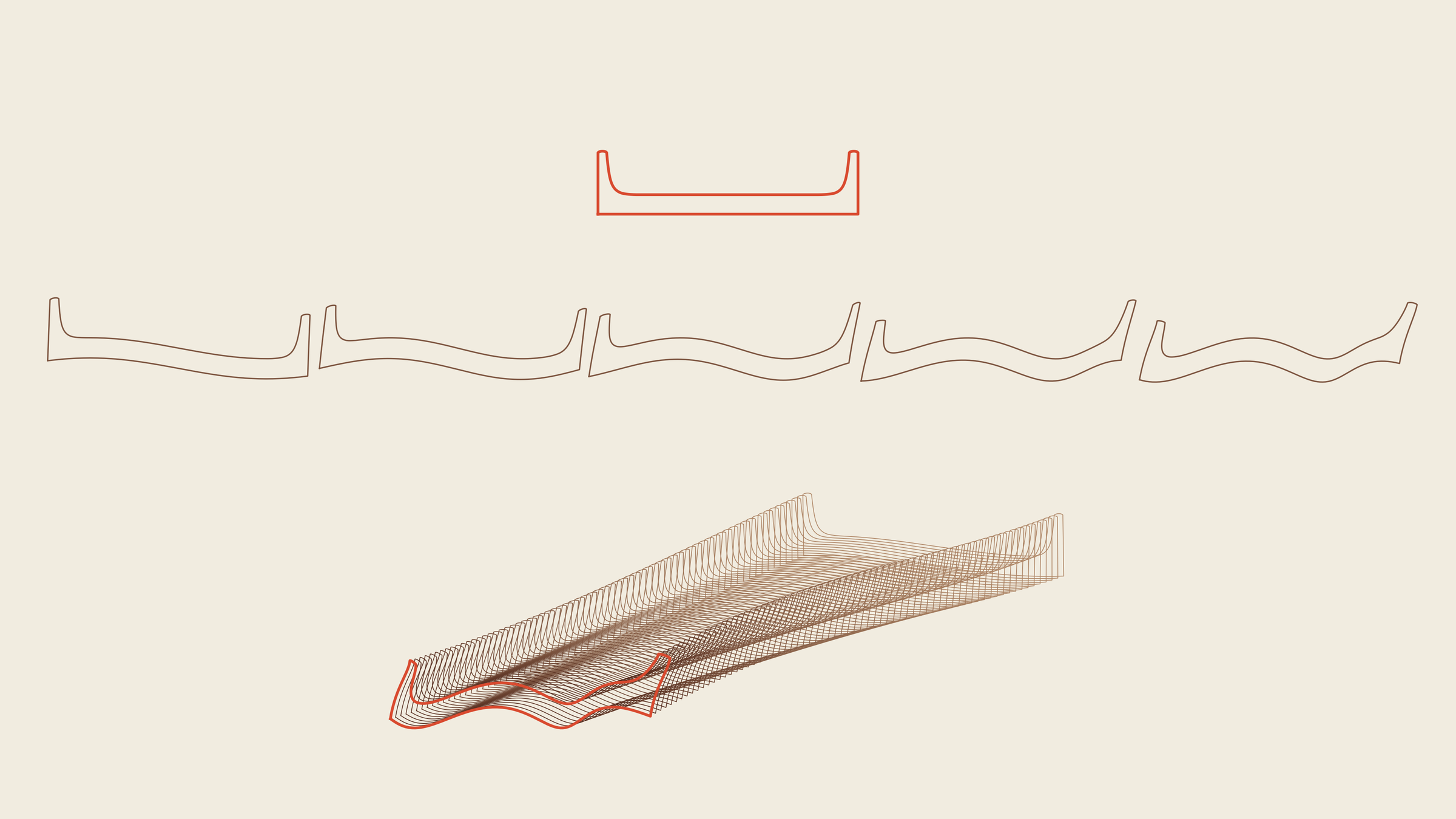
Then I move the shape through the field. Each draft is the bracket a little further along, so each is bent a little differently from the last, and stood one behind the next they make a surface. That is the whole reason the ground ripples the way it does. Nothing is modeling a surface. It is one outline, drawn again and again, somewhere new each time.
I chose Clifford over the others for one reason. Spiro and Wave put lobes and ripples on a line. Clifford bends the whole figure at once, slowly, so a bracket stays a bracket and an arch stays an arch however far they are pushed. I should say what it is not: the name comes from the Clifford attractor, but nothing is iterated here. The field is applied once to each draft.
Toward the edge the field eases off. By the last plane the field is at a little over a third of its strength and has let go of the mark altogether, so the mark arrives as drawn.
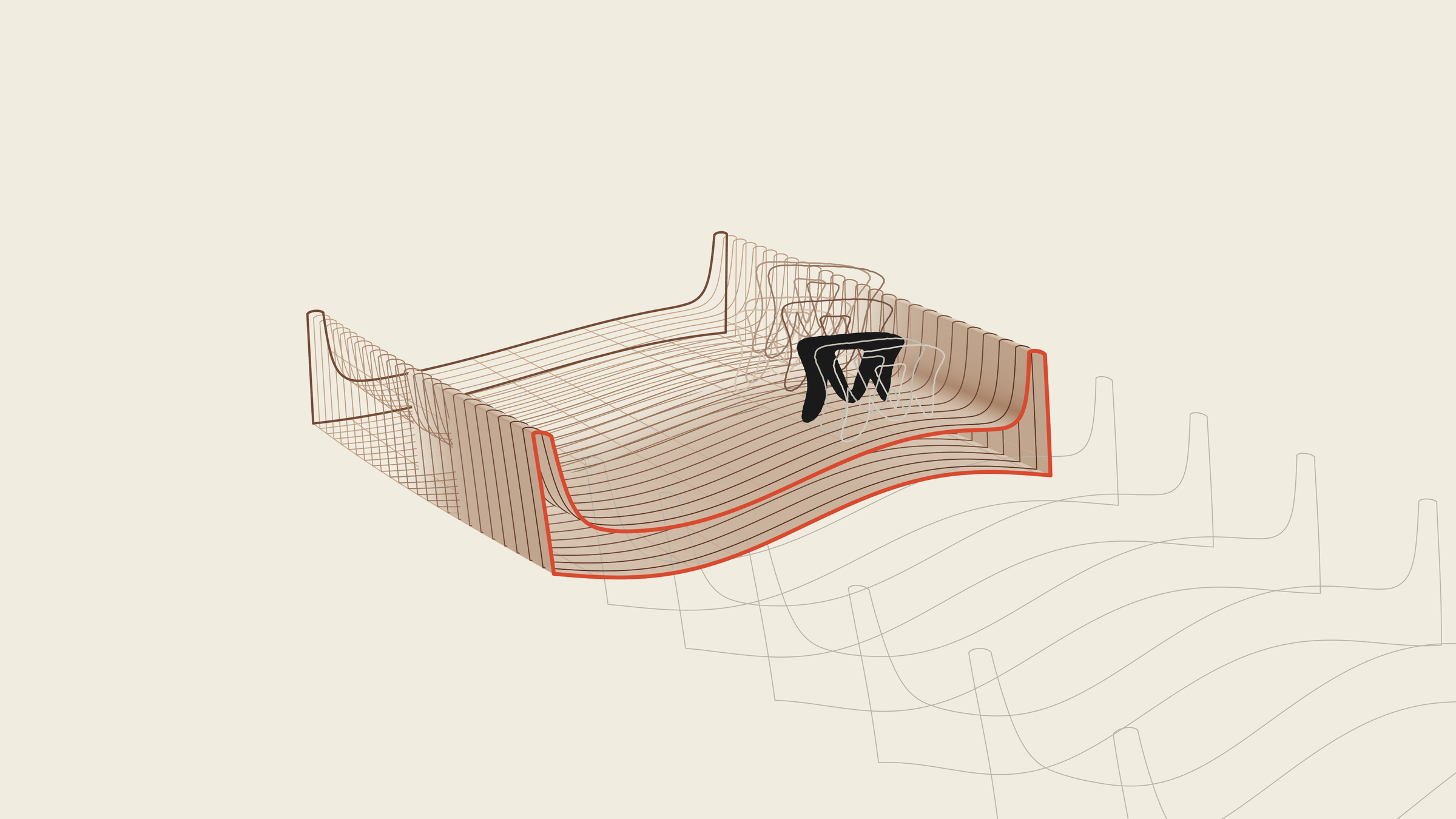
At the end nothing fills and nothing fades. The vermilion lines of the bracket and the arch slide back along the vault toward you and return, the way the location slider moves a cut through a stack in the instruments. One thin vermilion line makes the same move through the far ridges, in step.
That line is there to suggest what comes next. It ties the mark’s position on the cliff to the mountains: they are one place it could reach from where it stands. In this study I worked out the path and handed it to the model. In the next one the model maps its own.

I did not write the engine by hand. It was built in AI-assisted sessions, from five animated sketches I marked up, on top of Countermark’s families. The direction is mine, and so are the two figures, the arch, the startle and the edge.
A view of fields and waves is something to behold. We are all looking at one now.
A concept study and a short film. The first of the algorithm studies built as a story, and the set-up for the next one, where the model maps its own path.